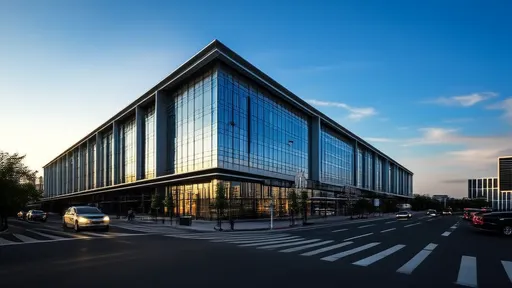
In the realm of architectural photography, where straight lines and geometric precision reign supreme, few tools are as revered—or as misunderstood—as the tilt-shift lens. Unlike conventional optics, these specialized lenses don’t just capture light; they bend reality itself, offering photographers an almost alchemical ability to correct distortion and manipulate perspective. The result? Buildings that stand tall and true, free from the converging verticals that plague standard wide-angle shots.
Why Architecture Demands Optical Precision
Anyone who’s pointed a camera upward at a skyscraper knows the problem: parallel lines appear to taper toward the sky, making structures seem to lean backward like a house of cards. This "keystoning" effect isn’t just an aesthetic concern—it’s a betrayal of architectural intent. Designers conceive buildings with specific proportions, and distortion can subtly alter their perceived balance and scale. For commercial photographers working with developers or architects, delivering images that match technical drawings isn’t optional; it’s contractual.
Enter the tilt-shift lens. By allowing the lens plane to shift parallel to the image sensor (shift function) or tilt at an angle to it (tilt function), these optics provide two critical corrections. The shift feature maintains parallel lines by keeping the camera sensor perfectly perpendicular to the subject, while the tilt function offers control over depth of field—a boon when photographing intricate facades where every detail matters.
The Hidden Mechanics of Perspective Control
What sets tilt-shift lenses apart is their mechanical complexity. Unlike zoom or prime lenses with fixed optical paths, tilt-shift designs incorporate rotating barrels and sliding elements. The shift mechanism literally moves the lens’s optical center away from the camera’s sensor plane, effectively repositioning the "viewpoint" without tilting the camera body. This mimics the effect of rising or falling front standards on large-format view cameras—the gold standard for architectural imaging since the 19th century.
Modern iterations like Canon’s TS-E 24mm f/3.5L II or Nikon’s PC NIKKOR 19mm f/4E ED push boundaries further. Multi-coating technologies combat flare when shooting glass-heavy buildings, while aspherical elements maintain edge-to-edge sharpness across shifts of up to ±12mm. Some even incorporate electromagnetic diaphragms for precise aperture control during tilt movements—a necessity when working at f/11 or narrower to keep entire structures in focus.
Creative Possibilities Beyond Correction
While perspective correction remains their primary function, tilt-shift lenses have gained cult status for their creative side effects. The tilt function’s ability to create wafer-thin planes of focus has spawned the "miniature effect," where cities appear as toy models. More practically, tilting the focus plane along a building’s facade allows photographers to maintain sharpness from foreground to infinity without resorting to impractical f-stops—a technique Ansel Adams pioneered with his "Scheimpflug principle" applications.
Architectural purists might scoff at such tricks, but commercial shooters increasingly blend technical precision with artistic flair. A dusk shot of a concert hall might use shift to keep columns perfectly vertical while employing tilt to render nearby trees as soft bokeh orbs—marrying documentary accuracy with emotive atmosphere.
The Learning Curve: Mastery Requires Muscle Memory
Owning a tilt-shift lens doesn’t guarantee great architecture photos. These tools demand physical dexterity most digital-era photographers lack. Adjusting shift while simultaneously rotating the lens barrel requires both hands, often while peering at a live view screen under bright sunlight. Composition becomes a dance of millimeter-precise movements—over-shift by 2mm, and you’ll introduce reverse keystoning; misalign tilt, and critical details slip out of focus.
Seasoned practitioners develop rituals. Many start by leveling their tripod using a hot shoe bubble meter, then rough-compose with the lens centered before applying shift. Others swear by live view magnification to check edge sharpness after each adjustment. The process is methodical, almost meditative—a far cry from spray-and-pray shooting modes.
Software Alternatives: Worthy Opponents or Poor Substitutes?
With post-processing tools like Lightroom’s Transform panel or specialized software such as DxO ViewPoint, some argue software can emulate tilt-shift effects. While these solutions can correct moderate perspective distortion, they come at a cost. Digital correction crops into the image (reducing resolution) and can’t replicate the optical quality of a properly shifted lens. More critically, they fail to address the depth-of-field control that tilt provides—a dealbreaker for large-format prints where every brick must be crisp.
That said, hybrid approaches are gaining traction. Photographers might use a 50mm tilt-shift lens for critical perspective work, then blend in wider shots (corrected in software) for context—a workflow that balances optical purity with practical flexibility.
The Future of Perspective Control
As mirrorless cameras dominate, manufacturers are rethinking tilt-shift designs. Sony’s patent filings suggest electronic shift mechanisms that could automate perspective adjustments, while computational photography might one day simulate tilt-shift effects in real time. Yet for now, the mechanical elegance of traditional tilt-shift lenses endures. There’s magic in watching a leaning tower straighten before your eyes—not through software tricks, but through the tangible interplay of optics and physics.
For architects documenting their life’s work or photographers chasing geometric perfection, these lenses remain indispensable. They remind us that sometimes, the most advanced solutions aren’t digital algorithms, but beautifully engineered tools that extend, rather than replace, human skill.

By /Aug 11, 2025

By /Aug 11, 2025

By /Aug 11, 2025

By /Aug 11, 2025

By /Aug 11, 2025

By /Aug 11, 2025

By /Aug 11, 2025

By /Aug 11, 2025

By /Aug 11, 2025

By /Aug 11, 2025

By /Aug 11, 2025

By /Aug 11, 2025
By /Aug 11, 2025

By /Aug 11, 2025

By /Aug 11, 2025

By /Aug 11, 2025

By /Aug 11, 2025

By /Aug 11, 2025

By /Aug 11, 2025

By /Aug 11, 2025
