The world of macro photography unveils a hidden universe, one that often escapes the naked eye. Among its most mesmerizing subjects are the intricate compound eyes of insects, structures so complex and beautifully designed that they rival the most sophisticated human-made optical systems. These multifaceted organs, evolved over millions of years, are not just functional marvels but also stunning visual spectacles when captured through the lens of a skilled photographer.
The Architecture of Insect Eyes
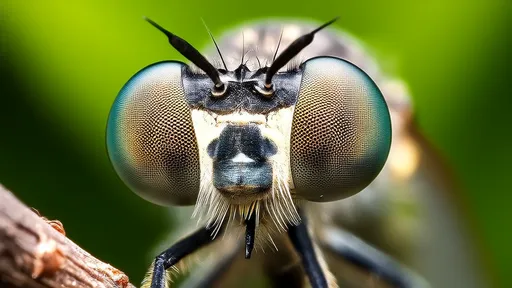
Unlike the single-lens eyes of vertebrates, insect eyes are composed of thousands of tiny optical units called ommatidia. Each ommatidium functions as an independent photoreceptor, capturing a small portion of the visual field. When combined, these units create a mosaic image, allowing insects to detect movement with extraordinary precision. The hexagonal arrangement of these facets gives the eyes a shimmering, jewel-like appearance, a feature that macro photographers often highlight to dramatic effect.
The surface of a compound eye is not smooth but rather a geometric masterpiece. Under magnification, the repeating patterns of ommatidia resemble the precision of a honeycomb or the intricate designs of stained glass. The way light interacts with these structures—refracting, reflecting, and sometimes diffracting—adds another layer of visual intrigue. Photographers who specialize in macro work often experiment with lighting angles to reveal the iridescent hues and metallic sheens that some insect eyes exhibit.
Challenges and Techniques in Capturing Compound Eyes
Photographing insect eyes at such close range is no small feat. The depth of field becomes razor-thin, often just a fraction of a millimeter, requiring precise focus stacking techniques to keep the entire eye in sharp relief. Even the slightest movement—from the insect or the photographer—can ruin a shot. Many macro photographers resort to early morning sessions when insects are still cool and less active, or they use specialized equipment like focus rails and diffused flash to freeze motion and control lighting.
Another challenge lies in the eyes themselves. Many insects have curved, bulbous eyes that distort reflections in fascinating ways. A skilled photographer can use this to their advantage, turning the eye into a natural mirror that reflects its surroundings. Some of the most striking images show entire landscapes or the photographer’s own silhouette mirrored in the insect’s eye, creating a surreal juxtaposition of scale and perspective.
The Aesthetic and Scientific Allure
Beyond their visual appeal, these photographs serve as valuable scientific records. Researchers studying insect vision or biomimicry often rely on high-resolution macro images to analyze the structure and function of ommatidia. The images can reveal variations between species—how the eyes of a dragonfly, optimized for hunting in flight, differ from those of a slow-moving beetle. For scientists and photographers alike, the compound eye is a testament to evolution’s ingenuity.
Yet, for many macro enthusiasts, the drive to photograph these eyes is as much about art as it is about science. There’s an undeniable magic in revealing a world that exists all around us, unseen. The way a fly’s eye glints like a cluster of topaz in sunlight or how a moth’s eye appears as a velvety black dome studded with microscopic sensors—these are moments of discovery that transcend mere documentation. They invite viewers to reconsider their place in a world teeming with unnoticed wonders.
Ethics and the Delicate Balance
As with all wildlife photography, ethical considerations must guide the pursuit of these images. Disturbing or harming insects for the sake of a photo is antithetical to the spirit of ecological appreciation. The best macro photographers develop techniques to work with living subjects without causing stress—using long lenses to maintain distance, avoiding bright lights that could disorient, and never manipulating creatures beyond their natural behaviors. The goal is to celebrate life, not exploit it.
In the end, macro photography of insect eyes does more than showcase technical skill or artistic vision. It builds a bridge between humans and the microcosms we often overlook. When we peer into the kaleidoscopic eye of a bee or the shimmering facets of a praying mantis, we’re granted a fleeting glimpse into an entirely different sensory world. And perhaps, in that moment, we gain not just a beautiful image, but a deeper humility toward the complexity of life on Earth.

By /Aug 11, 2025

By /Aug 11, 2025

By /Aug 11, 2025

By /Aug 11, 2025

By /Aug 11, 2025
By /Aug 11, 2025
By /Aug 11, 2025
By /Aug 11, 2025

By /Aug 11, 2025

By /Aug 11, 2025
By /Aug 11, 2025
By /Aug 11, 2025

By /Aug 11, 2025

By /Aug 11, 2025

By /Aug 11, 2025

By /Aug 11, 2025

By /Aug 11, 2025

By /Aug 11, 2025

By /Aug 11, 2025

By /Aug 11, 2025
