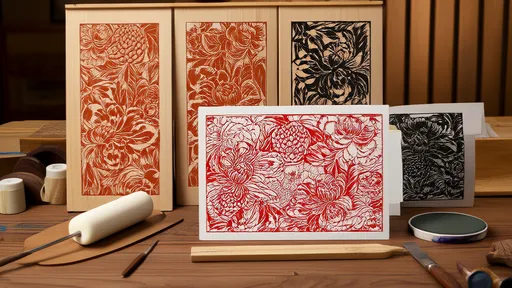
Woodblock printing, an ancient art form with roots in East Asia, has evolved over centuries into a sophisticated technique capable of producing intricate multicolor designs. Among the various challenges faced by printmakers, achieving precise color registration in multicolor woodblock prints stands as one of the most demanding aspects of the craft. The process, known as kento in Japanese or dui ban in Chinese, requires meticulous attention to detail and a deep understanding of material behavior.
Traditional woodblock printing relies on a system of registration marks carved into each block to ensure proper alignment of successive color layers. These marks, typically consisting of L-shaped corners and straight guidelines, must be absolutely identical across all blocks used in a single print. The slightest deviation—often less than half a millimeter—can result in blurred edges, unintended color mixing, or visible gaps between color fields. Master printers develop an almost intuitive sense for the relationship between carving precision, paper absorption, and pressure application.
The paper itself plays a crucial role in registration accuracy. Unlike Western printing papers, traditional Asian papers used for woodblock printing possess unique stretching properties when dampened. Printers must account for this expansion during the printing process, as paper that has absorbed moisture from previous color applications will have slightly different dimensions when subsequent colors are applied. This phenomenon requires printers to adjust their registration marks based on the paper's changing state throughout the printing sequence.
Modern practitioners have adapted traditional techniques to contemporary needs while maintaining the essential principles of precision registration. Some workshops now employ transparent registration sheets or light tables to verify alignment before printing begins. Others use modified versions of the traditional kento system that account for specific paper types or environmental conditions. The introduction of synthetic carving materials has also changed the registration equation, as these modern substrates respond differently to moisture and pressure compared to traditional cherry or boxwood blocks.
Beyond technical considerations, the philosophy of color registration in woodblock printing reflects broader artistic principles. The visible alignment—or intentional slight misalignment—of colors can become an expressive element in itself. Some contemporary artists deliberately play with registration tolerances to create vibration effects between colors or to suggest movement within static images. This artistic license builds upon rather than contradicts the technical mastery of precise registration, demonstrating how control and creativity coexist in this demanding medium.
The future of color registration in woodblock printing may see increased dialogue between traditional methods and digital technologies. Some studios now use digital proofs to test color relationships before carving begins, while others employ computer-assisted design to plan complex registration schemes. However, the physical act of aligning each impression by hand remains central to the craft, preserving the human element that gives woodblock prints their distinctive character. As the art form continues to evolve, the pursuit of perfect registration remains both a technical challenge and an artistic aspiration, connecting contemporary practitioners with centuries of printing tradition.
By /Aug 11, 2025

By /Aug 11, 2025

By /Aug 11, 2025
By /Aug 11, 2025

By /Aug 11, 2025
By /Aug 11, 2025

By /Aug 11, 2025

By /Aug 11, 2025

By /Aug 11, 2025
By /Aug 11, 2025

By /Aug 11, 2025

By /Aug 11, 2025

By /Aug 11, 2025

By /Aug 11, 2025
By /Aug 11, 2025

By /Aug 11, 2025

By /Aug 11, 2025
By /Aug 11, 2025

By /Aug 11, 2025

By /Aug 11, 2025
