In the quiet corners of printmaking studios, an ancient alchemy unfolds—one where grease and water wage a delicate battle upon limestone slabs. Stone lithography, a 19th-century invention that revolutionized art reproduction, continues to captivate contemporary artists with its unpredictable textures. The technique relies on a fundamental antagonism: oil-based inks cling to drawn marks while repelling water-soaked blank areas. But within this scientific principle lies an ocean of artistic accidents—the granular blooms, feathery bleeds, and volcanic crackles that transform mechanical reproduction into a dance of chance.
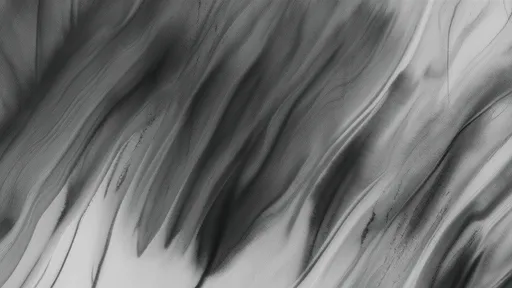
What makes lithographic textures so hypnotic isn’t their precision, but rather their defiance of control. Unlike digital brushes that simulate "randomness" through algorithms, the stone’s surface—with its fossilized seashell fragments and mineral veins—reacts to humidity, pressure, and the artist’s touch in ways that can’t be fully anticipated. When diluted ink skids across a dampened stone, it branches like lightning frozen mid-strike. These aren’t flaws; they’re the stone’s voice whispering through centuries of geological memory.
The Dance of Hydrophobia
At the molecular level, every lithograph is a theater of hydrophobic drama. Artists exploit this by adjusting the viscosity of their inks—a thicker mixture holds its ground like clustered soldiers, while a washier consistency retreats into frayed edges. Some contemporary practitioners deliberately "starve" their rollers of ink, allowing the stone’s tooth to scrape through pigment in arid streaks. Others flood the surface to let puddles congeal into archipelagos of tone. The magic occurs in the transfer: paper pressed against the stone captures not just the image, but the topography of ink pools and water channels.
Master printer Élodie Gérard describes the process as "negotiating with chaos." In her Paris atelier, she demonstrates how a single pass can yield radically different results—blotting paper choices (Japanese kozo vs. German etching paper) siphon moisture at varying speeds, while atmospheric humidity alters water’s surface tension. "You’re not printing an image," she says, wiping her hands on a smudged apron, "you’re printing a moment in the life of water."
Contemporary Alchemists
While traditional lithography demanded meticulous planning, today’s artists weaponize its unpredictability. Chinese-American artist Lin Yan suspends rice paper above inked stones, allowing capillary action to pull pigments into dendritic forms resembling lung tissue or root systems. Berlin-based collective Druckfehler incorporates actual rainwater into their process—the mineral content interacts with limestone to create crystalline blooms no synthetic spray could replicate.
Perhaps most strikingly, the resurgence of "ghost prints"—pulling second impressions from residual ink—has gained momentum. These faint afterimages, once considered waste, now appear in galleries as palimpsests documenting the stone’s memory. Australian artist James Clayden compares them to "echoes in a canyon; each repetition less distinct but more emotionally charged."
The Stone’s Revenge
Yet the medium has its rebellions. Veteran lithographers swap horror stories of stones that "go mute"—suddenly refusing to hold drawings despite proper preparation. Some attribute this to quantum-scale changes in the limestone’s porosity; others blame spiritual whimsy. Restoring such stones involves ritualistic sanding that can erase decades of previous artworks, a sobering reminder of the medium’s physicality.
As digital tools dominate visual culture, lithography’s water-stained imperfections gain new resonance. They stand as testament to the poetry of process, where an artist’s intention must collaborate with elemental forces. The resulting works don’t just depict nature—they are nature, shaped by the same physics that frosts windows or carves river deltas. In an age of pristine vectors, these inky contingencies feel startlingly alive.
By /Aug 11, 2025

By /Aug 11, 2025
By /Aug 11, 2025
By /Aug 11, 2025

By /Aug 11, 2025
By /Aug 11, 2025
By /Aug 11, 2025
By /Aug 11, 2025
By /Aug 11, 2025
By /Aug 11, 2025
By /Aug 11, 2025

By /Aug 11, 2025
By /Aug 11, 2025

By /Aug 11, 2025
By /Aug 11, 2025
By /Aug 11, 2025
By /Aug 11, 2025
By /Aug 11, 2025
By /Aug 11, 2025
By /Aug 11, 2025
